Check your Windows PC, understand what may need attention, and contact your own computer engineer when you need help. It opens when you want it — not the other way round.
Version 1.14.1 · Windows 10 and 11, 64-bit and 32-bit · 55 MB · no admin rights needed · details, checksum and release notes
Already installed? You do not need this file: the app tells you itself when a newer version exists and installs it in place after checking the published checksum.
Six steps, and the last one is a person who already knows your PC.
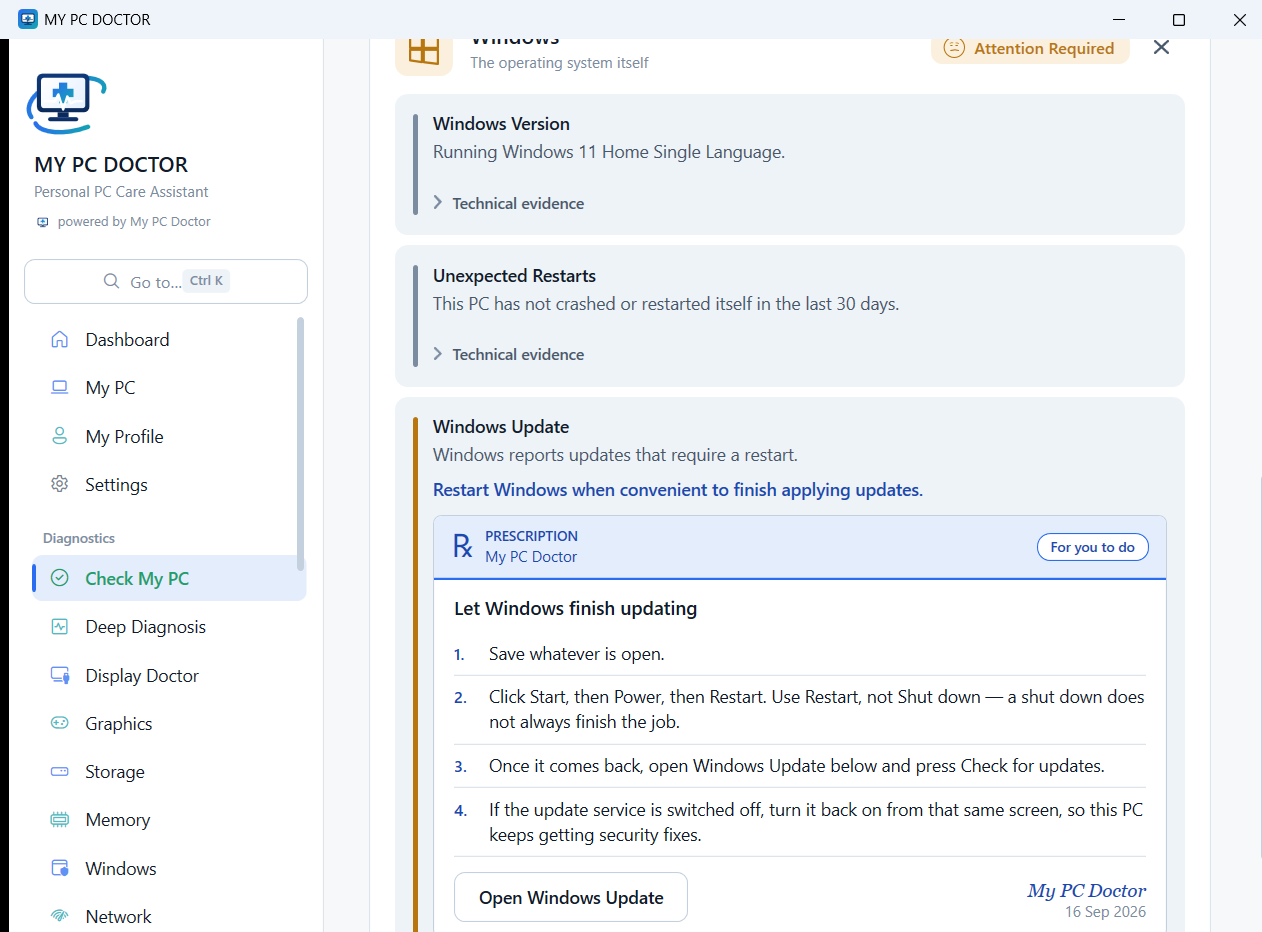
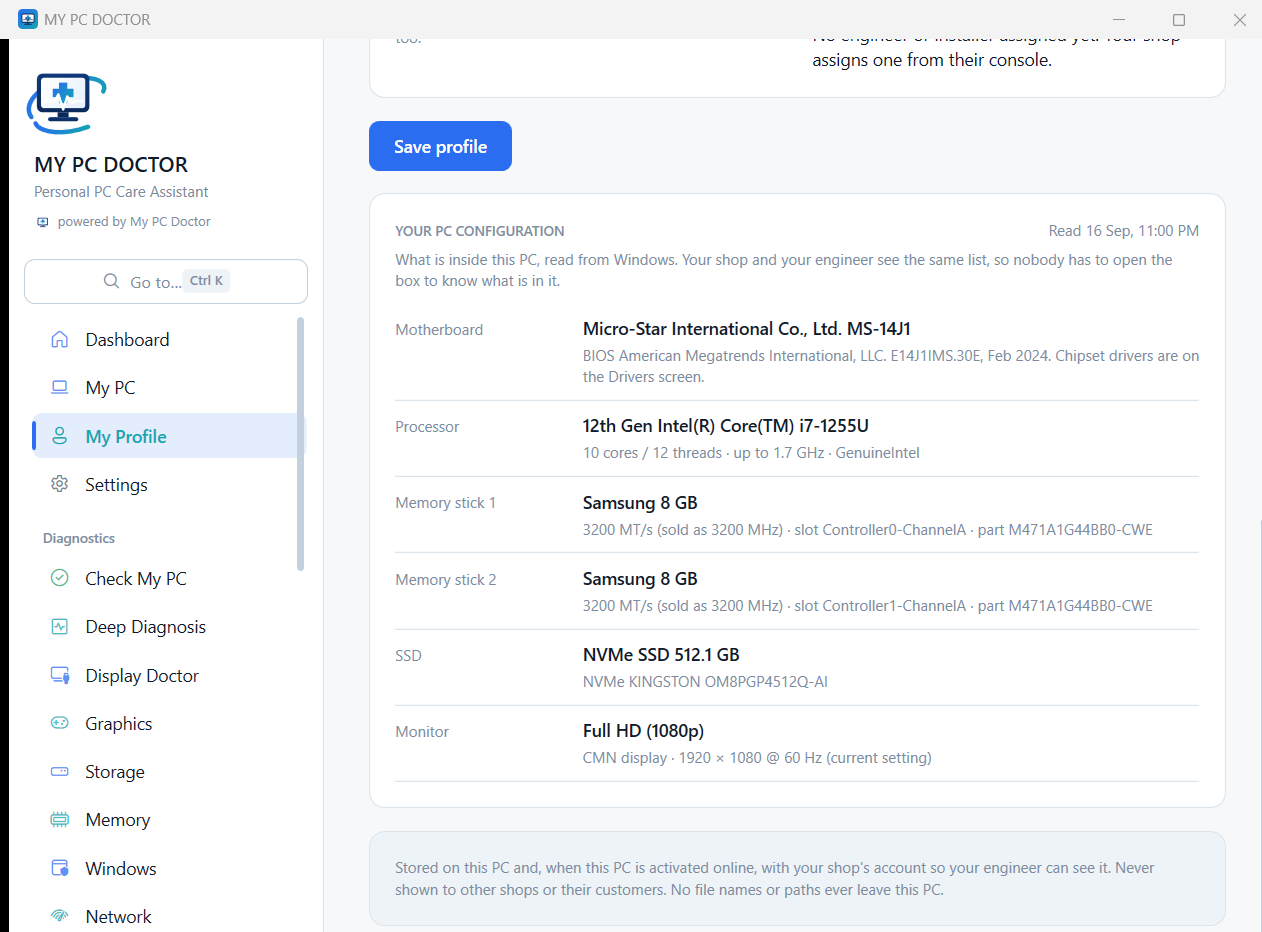
Two screens from the running app: a finding with its prescription, and the parts list your shop sees too.
Your PC's parts listed one by one, each with a picture of what it is, a line about what it does, and a face that says how it is doing. Details and evidence sit underneath for anyone who wants them.
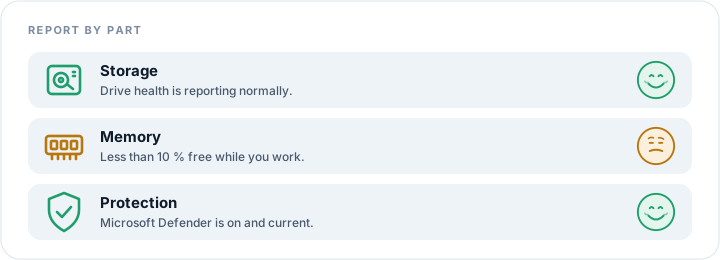


Findings say how certain they are. Where the cause cannot be proven, the app lists the possibilities instead of picking one.
Eight checks in one press, plus a Deep Diagnosis when you want the measurements that take time. See the full list.

Motherboard and BIOS, processor, every memory stick with its speed, every drive, and the monitor classed as Full HD, 2K or 4K.
Cores, threads and clock; installed memory, current pressure, per-stick speed and Windows' hardware error log.

Drive health, free space, the interface link it negotiated, and a read-speed test you start yourself.

The active adapter and its driver; your resolution and refresh rate against what the monitor reports.

Version and build, pending restarts, update state, and the blue screens Windows recorded, explained.

Adapter present and enabled, and the link speed it negotiated — without blaming your cable for it.

Devices Windows is unhappy about, with the Device Manager code translated: missing, failing, or simply switched off.
Board, BIOS vendor, version and date, with the maker's official page. Read-only: nothing is ever flashed.
A drive can be perfectly healthy and still be slow, because of the port it sits in, the link it negotiated, or how full it is. Those are four different questions, and the app answers them separately.
Analysis with its evidence attached. No FPS promises, no percentage bottlenecks, no overclocking.
Graphics, memory, storage and display read together, with your monitor's resolution and refresh rate as context.
Processor and graphics utilization sampled over a real observation window, reported as what was observed.
A verdict only when the measurements are decisively lopsided. Below that bar it reports a workload shape, never a number.
Adapter, VRAM, driver state, the vendor control panel, and NVIDIA CUDA or AMD ROCm presence as a plain summary.

Classifies what could be adjusted on this hardware, and applies nothing. No clocks, voltages or fan curves are ever changed.

What your monitor was made for against what Windows is set to — the difference matters more than most settings guides admit.
Every action is listed with exactly what it will change, and nothing happens until you press that one thing. It says honestly when something cannot be undone.
There is no "Optimize Everything" button.
Computer shops and installers register once. Their name, number and logo then appear on every PC they set up, and their customers reach them.
Inside the app, in the sidebar, on every PC that shop installs.
One tap to the person who actually knows the machine.
The problem and the diagnostic evidence in one step, with the status coming back inside the app.
Give every PC you sell a digital after-sales service layer — your branding, your engineer, your PC register.
Reviews written inside the app by customers who have had My PC Doctor for at least a month. We publish them with their name and town, and nothing else.
The check runs on your own Windows PC. Here is the whole boundary.
Written from what the app can genuinely determine — and what it cannot.
 MY PC DOCTOR